Global sourcing of Rigging Eye Bolts demands more than comparing prices, coatings, or delivery dates. A suitable bolt must match the lifting method, working load limit, thread specification, material grade, and intended load direction. The wrong choice may look flawless on a warehouse shelf.
Grand View Research identifies industrial fasteners as a broad, expanding market shaped by construction, energy, transportation, and manufacturing demand. IMARC’s lifting equipment research also highlights stronger requirements for traceability, inspection, and workplace safety. These findings matter when comparing suppliers across different regions. Product photographs rarely reveal thread engagement, proof-test records, or heat-treatment quality.
Rigging specialist John M. Skelly offers a useful warning: “A rated component is not automatically a safe lift.” The principle is simple.
Read the details.
A vertical-load eye bolt is not automatically approved for angular loading. DIN, ASME, and manufacturer instructions may use different terminology, markings, and safety factors. Buyers should request certificates, dimensional drawings, batch traceability, and clear working-load tables. Check shoulder contact, shank length, corrosion protection, and temperature limits. Ask whether testing covers the complete assembly, not only the steel.
Supplier audits should include factory inspection, sample verification, and packaging checks. A low quotation can hide expensive rework. Even experienced buyers can overlook thread tolerance or missing instructions. That weakness deserves honest review.
This guide explains how to choose Rigging Eye Bolts for global sourcing, balancing technical performance, supplier reliability, documentation, and real lifting conditions.
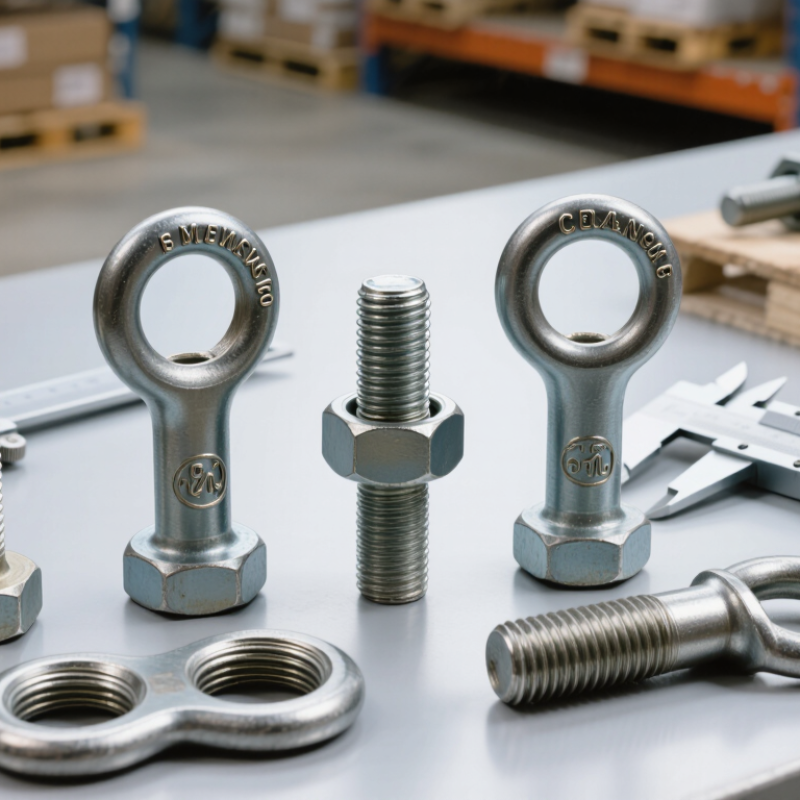
Rigging eye bolts differ in shape, loading direction, and installation requirements. The most common types are shoulder eye bolts, plain eye bolts, and swivel lifting rings. A shoulder eye bolt has a collar beneath the eye, helping it resist limited side loading when fully seated. A plain eye bolt suits straight, vertical lifting only. Never assume a shoulder makes every angle safe. Swivel lifting rings rotate with the load and may suit machinery with changing pull directions.
Match the eye bolt to the real application. Use forged alloy steel for repeated lifting, where strength and traceability matter. Stainless steel may fit corrosive environments, but its lifting capacity requires careful verification. Check the working load limit, thread size, shank length, lifting angle, and surface condition. The receiving hole must provide full thread engagement. Damaged threads, bent eyes, or missing markings are clear rejection points.
Tips: Request material certificates, load-test records, dimensional drawings, and inspection photos from suppliers. Confirm whether the stated capacity applies vertically or at an angle. Packaging should protect threads from impact and moisture. A common sourcing mistake is comparing price before comparing load ratings. I have seen specifications look similar while applications differ sharply. Recheck everything. When uncertainty remains, ask a qualified lifting engineer to review the selection before purchase.
When sourcing rigging eye bolts globally, begin with the real lifting scenario, not the catalogue capacity. Record the lifted mass, sling angle, attachment direction, lift frequency, and exposure to impact or corrosion. A 1,000-kilogram load does not create the same force at every angle. As the sling angle narrows, leg tension rises sharply. Keep it conservative. Determine the required working load limit (WLL) for the complete connection, including the bolt, nut, washer, and lifting point. Never treat breaking load as usable capacity.
Select a safety factor that matches the application, local requirements, and tested supplier data. The factor should cover dynamic movement, uneven loading, wear, and uncertainty in field conditions. A static warehouse lift differs from a repeated outdoor lift exposed to wind and vibration. Check whether the eye bolt is rated for vertical loading only or for angular loading with a specified reduction. Do not guess. Request test reports, material specifications, heat-treatment records, dimensional drawings, and traceable inspection documents. Thread fit matters too. A perfect-looking bolt can fail with poor engagement or damaged threads.
During supplier evaluation, compare samples against drawings before approving volume production. Inspect the eye opening, shoulder contact, thread profile, surface finish, and markings. Load-test evidence should identify the method, date, and acceptance criteria. This paperwork is easy to overlook. It should not be. Packaging also matters when parts cross humid ports or remain in storage. Use corrosion protection suited to the environment, then inspect before use. One uncomfortable lesson is that a neat certificate cannot replace a competent pre-lift inspection. Recheck the plan when the load, angle, or equipment changes.
How to Choose Rigging Eye Bolts for Global Sourcing?
Selecting materials, threads, and corrosion protection requires more than comparing unit prices. ASME B30.26 treats rigging hardware as load-bearing equipment, so buyers should verify rated capacity, proof testing, and traceability. Forged carbon or alloy steel suits demanding lifting applications, but material certificates must match the ordered grade. Stainless steel can resist moisture better, although it is not automatically stronger. Check the manufacturer’s test evidence.
Threads deserve equal attention. Metric and Unified threads are not interchangeable, even when they appear visually similar. Confirm diameter, pitch, thread class, engagement length, and shoulder design. A shoulder eye bolt can handle limited angular loading only when installed correctly. A non-shoulder type usually requires straight, vertical loading. Small mistakes here become expensive failures.
Corrosion protection is not decoration. The NACE IMPACT study estimated global corrosion costs at about US$2.5 trillion annually, equal to roughly 3.4% of global GDP. That figure explains why coating selection matters. Zinc plating may suit controlled indoor environments, while hot-dip galvanizing offers thicker protection outdoors. High-strength plated parts also require careful hydrogen-embrittlement controls. Stainless steel may be preferable near salt spray, but crevice corrosion can still appear.
Tips: Ask for heat numbers, load-test records, coating thickness, and dimensional inspection reports. Specify the thread system in every purchase order. Inspect the eye, shoulder, and threads after arrival. I have seen “corrosion-resistant” treated as “corrosion-proof.” It is not. Keep a little skepticism.
Selecting Materials, Threads, and Corrosion Protection
Material comparison: The chart shows the minimum tensile strength specified for common metric fastener material classes. Higher tensile strength does not automatically mean a higher working load limit; eye-bolt geometry, forging quality, installation angle, safety factor, and certification must also be verified.
Thread selection: Use ISO metric coarse threads or Unified National Coarse threads according to the equipment design and destination market. Confirm nominal diameter, pitch, thread engagement, tolerance, and compatibility with the receiving nut or tapped hole.
Corrosion protection: Use zinc or hot-dip galvanizing for general outdoor exposure, stainless steel for clean or mildly corrosive environments, and a suitable engineered coating or corrosion-resistant alloy for marine or chemical service. Avoid mixing incompatible metals where galvanic corrosion may occur.
Reference values are minimum tensile strengths associated with commonly used ISO metric fastener property classes; they are material references, not rated capacities for lifting hardware.
Verifying Standards, Certification, and Supplier Quality
A rigging eye bolt is a lifting component, not a generic threaded fastener. Confirm the required standard before comparing prices. ISO 3266 covers forged steel eyebolts for general lifting purposes, while ASME B30.26 addresses rigging hardware used in lifting operations. DIN 580 may apply to specific metric lifting eye bolts. Check load direction, thread size, working load limit, and shoulder design. A plain eye bolt should not be used for angular loading without documented approval.
Certification needs careful review. Request a material test certificate, heat number, proof-load record, dimensional report, and batch-level traceability. The certificate should match markings on the bolt, packaging, and purchase order.
Paper is not enough.
ISO’s 2023 Survey reported more than 1.26 million ISO 9001 certificates worldwide, but ISO 9001 confirms a quality system, not automatic product conformity. Ask for calibration records, inspection plans, nonconformance procedures, and independent test evidence where risk justifies it.
During receiving inspection, examine thread damage, cracks, corrosion, distorted eyes, and missing markings. Photograph each batch before installation. Supplier audits should include forging controls, heat treatment, hardness testing, and final visual inspection. The ILO’s 2023 report estimated 2.93 million work-related deaths annually, showing why small lifting components deserve serious control.
A supplier may pass an audit and still ship the wrong grade. That possibility deserves a second check.
Choosing rigging eye bolts for global sourcing requires more than comparing unit prices. Start with the working load, load direction, thread size, material grade, and surface protection. Eye bolts designed for vertical lifting may fail under side loading. That detail matters.
Send suppliers a controlled drawing with tolerances, thread specifications, eye dimensions, markings, and packaging requirements. Request material certificates, heat numbers, dimensional reports, and proof-load records before production. A qualified inspector should check thread fit, eye alignment, surface cracks, hardness, and identification marks. Magnetic particle testing may help detect surface defects on suitable steel components. Do not guess.
Inspection should happen at several points, not only before shipment. Early checks can reveal incorrect steel or tooling, while final checks confirm quantity and packaging. In practice, a clean report does not always prove consistent production. I once learned that photographs can hide thread damage and poor corrosion protection. Physical sampling remains important.
Global delivery creates separate risks. Confirm carton strength, moisture barriers, pallet dimensions, labeling, and document accuracy. Small mismatches can delay customs clearance or create warehouse confusion. Agree on inspection windows, replacement procedures, and responsibility for transport damage. Keep buffer time for port congestion and rework. Dates can slip. A reliable sourcing plan leaves room for mistakes, because even a strong supplier may misunderstand one drawing revision.
| Evaluation Dimension | Recommended Requirement | Relevant Technical Basis or Evidence | Main Global Sourcing Risk | Inspection and Acceptance Control | Delivery Control | Risk Level |
|---|---|---|---|---|---|---|
| Applicable Standard | Specify the governing standard before requesting quotations. Common references include forged steel lifting eye bolt standards such as ISO 3266, together with applicable national or regional requirements. | Purchase specification, approved drawing, standard edition, and intended lifting application. | Suppliers quote visually similar products manufactured to different dimensions, capacities, or testing rules. | Review the standard stated on the quotation, drawing, product marking, inspection report, and certificate package. | Include the exact standard and revision in the purchase order and shipping documents. | High |
| Eye Bolt Type | Choose a plain eye bolt only for loads aligned with the bolt axis. Use a shoulder-pattern eye bolt when the design and approved instructions permit limited angular loading. | Application drawing, lifting arrangement, manufacturer load chart, and engineering approval. | A plain eye bolt may be used for side loading, creating bending stress and a substantial reduction in safe working capacity. | Confirm eye-bolt type, shoulder geometry, seating surface, and approved loading direction. | Separate different types by packaging label and use clear product photographs in the packing record. | High |
| Working Load Limit | Specify the required working load limit (WLL) for the exact configuration, including sling angle, number of legs, connection method, and load direction. | Standardized WLL marking, tested load chart, lifting plan, and engineering calculation where required. | A nominal diameter alone does not establish lifting capacity; capacity can change with geometry, material, thread engagement, and loading angle. | Verify permanent marking, dimensional identity, and the WLL against the approved technical data. | Do not mix products with different WLLs in one carton or pallet; apply lot-level identification. | High |
| Thread Compatibility | Define thread diameter, pitch, tolerance class, thread form, and whether the thread is metric or inch-based. | Controlled engineering drawing, calibrated thread gauges, and mating-part specification. | Metric and inch threads can appear similar but may not engage correctly, causing thread damage or loss of preload. | Check major diameter, pitch, thread length, gauge results, and fit with an approved mating part. | Protect threads with caps or separators and prevent contact with sharp metal during transport. | High |
| Thread Engagement and Seating | Require full and clean engagement with the load-bearing member. For shoulder eye bolts, the shoulder should seat firmly against a suitable flat surface when the design requires it. | Installation instruction, joint drawing, required engagement length, and torque guidance where specified. | Insufficient engagement, bottoming out, dirt, damaged threads, or an uneven seating surface can reduce the connection strength. | Inspect the mating hole, thread condition, shoulder contact, and installation record before use. | Ship installation instructions with each lot and keep mating components protected from contamination. | High |
| Material and Heat Treatment | Use the material grade and heat-treatment condition specified for the application. Forged steel is commonly selected for lifting eye bolts; material selection must consider strength, toughness, and temperature. | Material certificate with heat number, chemical composition, mechanical properties, and heat-treatment record where applicable. | Substitution with an unapproved material or inconsistent heat treatment can cause inadequate strength or brittle failure. | Review certificates, verify heat numbers, and perform hardness or chemical verification when required by the inspection plan. | Keep material certificates linked to carton, pallet, and batch identification. | High |
| Forging Quality | Require a sound forged body with no cracks, laps, folds, sharp transitions, or unauthorized weld repairs. | Approved forging process, visual inspection criteria, and non-destructive examination requirement when specified. | Surface defects or repair welding may be concealed by coating and can become critical under cyclic lifting loads. | Perform 100% visual inspection; use magnetic particle testing for suitable ferromagnetic steel parts when required by the purchase specification. | Pack parts to prevent impact damage that could create new nicks or distortions. | High |
| Dimensional Accuracy | Control overall length, eye inside diameter, eye outside diameter, shoulder diameter, thread length, and any critical radii according to the approved drawing. | Dimensioned drawing, calibrated measuring equipment, and first-article or batch inspection report. | Dimensional variation may prevent correct sling-hook fit, seating, or interchangeability with existing equipment. | Use calibrated gauges and sampling plans; record actual measurements rather than only pass/fail results. | Release shipment only after the dimensional report is approved for the relevant production lot. | Medium |
| Marking and Traceability | Require durable identification such as size, WLL where applicable, material or grade reference, and production lot or heat traceability as specified. | Permanent marking on the product, batch record, certificate, and packing list. | Unmarked or mixed lots make it difficult to verify capacity, recall defective products, or investigate an incident. | Compare product markings with the certificate, purchase order, inspection report, and packaging labels. | Use one traceable lot per inner package where practical and retain photographs before container loading. | High |
| Corrosion Protection | Select an appropriate finish for the operating environment, such as plain, oiled, plated, or coated steel, without covering critical defects or interfering with threads. | Coating specification, corrosion exposure requirement, restricted-substance requirements, and storage conditions. | Incorrect coating thickness may affect thread fit; corrosion during ocean transport can damage threads and reduce service life. | Inspect coating coverage, adhesion, thread condition, visible corrosion, and packaging desiccant where required. | Use corrosion-inhibiting packaging, sealed inner bags, desiccant, and dry storage instructions for sea freight. | Medium |
| Proof or Performance Testing | Require proof or performance testing in accordance with the selected standard and approved inspection plan. Do not apply a generic test load without engineering or standard support. | Test procedure, calibrated test equipment, load record, acceptance criteria, and test-lot identification. | Testing at an unsuitable load, incorrect fixture, or uncalibrated equipment can produce misleading results. | Review calibration certificates, test method, test load, duration, permanent deformation criteria, and traceability. | Shipment should be released only after test records and nonconformance disposition are approved. | High |
| Inspection Sampling | Use 100% visual and marking inspection for safety-critical characteristics, with a documented sampling plan for dimensional checks unless the contract requires 100% measurement. | Inspection and test plan, defined acceptance quality limit, critical defect classification, and inspector qualification. | Unclear sampling rules may allow critical defects to pass or create disputes between buyer and supplier. | Approve the inspection plan before production and record sample size, lot size, defects, and corrective action. | Require a final inspection release note before booking the shipment. | Medium |
| Supplier Qualification | Evaluate forging capability, heat-treatment control, testing capacity, traceability, quality-system maturity, and experience with safety-critical lifting components. | Quality questionnaire, process audit, sample approval, certificate review, and corrective-action history. | A low quotation may reflect missing process controls, subcontracted heat treatment, or incomplete documentation. | Conduct a document audit and, for critical applications, an on-site or remote process audit before mass production. | Approve alternate production sites and subcontractors in writing before use. | High |
| Documentation Package | Define required documents before order placement: drawing, certificate of conformity, material certificate, inspection report, test report, packing list, and commercial invoice. | Document checklist linked to purchase-order and lot numbers. | Missing certificates can delay customs clearance, customer approval, or release for installation. | Perform document review before shipment and verify consistency of quantities, sizes, lot numbers, and descriptions. | Send scanned documents before vessel departure or dispatch and place protected originals with the agreed shipment documents. | Medium |
| Packaging and Handling | Use strong cartons or crates with internal separation, thread protection, moisture control, and clear lot labels. | Packaging specification, gross and net weight, package dimensions, lifting points, and stacking limits. | Loose metal parts may impact one another, damage threads, lose labels, or suffer corrosion during multimodal transport. | Inspect package integrity, count, labels, thread caps, moisture protection, and loading photographs. | Confirm container loading plan, weight distribution, and protection against seawater, condensation, and crushing. | Medium |
| Lead-Time Planning | Use a milestone schedule covering drawing approval, raw-material procurement, forging, heat treatment, machining, coating, inspection, documentation, and transport. | Supplier production schedule with inspection hold points and agreed shipping window. | Late material certificates, rework, inspection failure, or port congestion can move the delivery date. | Track progress at defined milestones and require early notice of any deviation. | Allow separate contingency for production and international transit; do not combine factory lead time with transit time. | Medium |
| Incoterms and Responsibility | State the agreed Incoterms rule, named place, insurance responsibility, export documents, import clearance responsibility, and transfer-of-risk point. | Commercial contract, purchase order, freight quotation, and insurance certificate where applicable. | Unclear responsibility may cause unexpected freight charges, uninsured loss, customs delays, or document gaps. | Review contract consistency before order confirmation and verify shipping documents against the named place. | Use a written logistics handoff covering booking, container loading, document release, and arrival notification. | Medium |
| Final Receiving Inspection | Quarantine the shipment until quantity, identity, markings, packaging condition, documents, and visible product condition have been verified. | Receiving checklist, purchase order, approved drawing, inspection report, and certificate package. | Damaged, mixed, or undocumented parts may enter service before the discrepancy is identified. | Check cartons and products by lot, photograph damage, verify critical dimensions, and record nonconformities. | Maintain quarantine and traceability until quality release is formally completed. | High |
| Service-Life Management | Define inspection intervals, discard criteria, storage conditions, and rules for removing parts with cracks, deformation, thread damage, severe corrosion, or illegible markings. | Internal lifting-equipment procedure, applicable regulations, risk assessment, and user training records. | A compliant product can become unsafe through overload, shock loading, corrosion, wear, or unauthorized modification. | Conduct pre-use and periodic inspections; never repair, weld, or modify a lifting eye bolt without documented engineering approval. | Store indoors or in a protected dry area, separated by size and lot, with inspection status visible. | High |
Record the load mass, sling angle, attachment direction, lifting frequency, and environmental exposure. A 1,000-kilogram load can create much higher tension at narrow sling angles.
The working load limit applies to the complete connection. Include the eye bolt, nut, washer, and lifting point. Breaking load is not a usable lifting capacity.
Match it to the application, local requirements, and verified supplier data. Consider movement, uneven loading, wear, vibration, and uncertain field conditions. Conservative choices help.
No. Some eye bolts are rated only for vertical lifting. Angular loading may require a specified capacity reduction. Never guess the permitted direction.
Request material specifications, test reports, heat-treatment records, drawings, and traceable inspection documents. Proof-load records should show the method, date, and acceptance criteria.
Compare samples with the controlled drawing. Inspect eye alignment, shoulder contact, thread profile, markings, surface finish, and hardness. Check thread engagement carefully.
No. A neat certificate can still miss thread damage or weak corrosion protection. Physical sampling remains important. This is an uncomfortable lesson.
Confirm carton strength, moisture barriers, pallet dimensions, labels, and document accuracy. Allow buffer time for port delays, rework, and replacement shipments. Dates can slip.
Recheck the lifting plan whenever the load, angle, or equipment changes. A previous approval may no longer apply. Do not rely on memory.
Choosing the right Rigging Eye Bolts for global sourcing requires a structured evaluation of performance, safety, and supply reliability. Start by identifying the appropriate eye bolt type for the intended lifting, anchoring, or rigging application, while considering installation direction, load movement, and working environment. Calculate the required working load limit and apply suitable safety factors to account for shock loads, uneven forces, and repeated use. Material selection should match the operating conditions, with attention to thread design, dimensional compatibility, strength, and protection against corrosion, moisture, chemicals, or temperature changes.
Before placing an order, verify that the products meet relevant technical standards and are supported by accurate test reports, traceability documents, and consistent quality-control procedures. Supplier evaluation should include manufacturing capability, inspection systems, sampling plans, and clear communication of specifications. For international purchasing, also manage risks related to packaging, transportation, customs documentation, delivery schedules, and incoming inspection. A well-planned sourcing process helps ensure that Rigging Eye Bolts arrive on time, conform to requirements, and perform safely throughout their service life.

Rui De Tai